
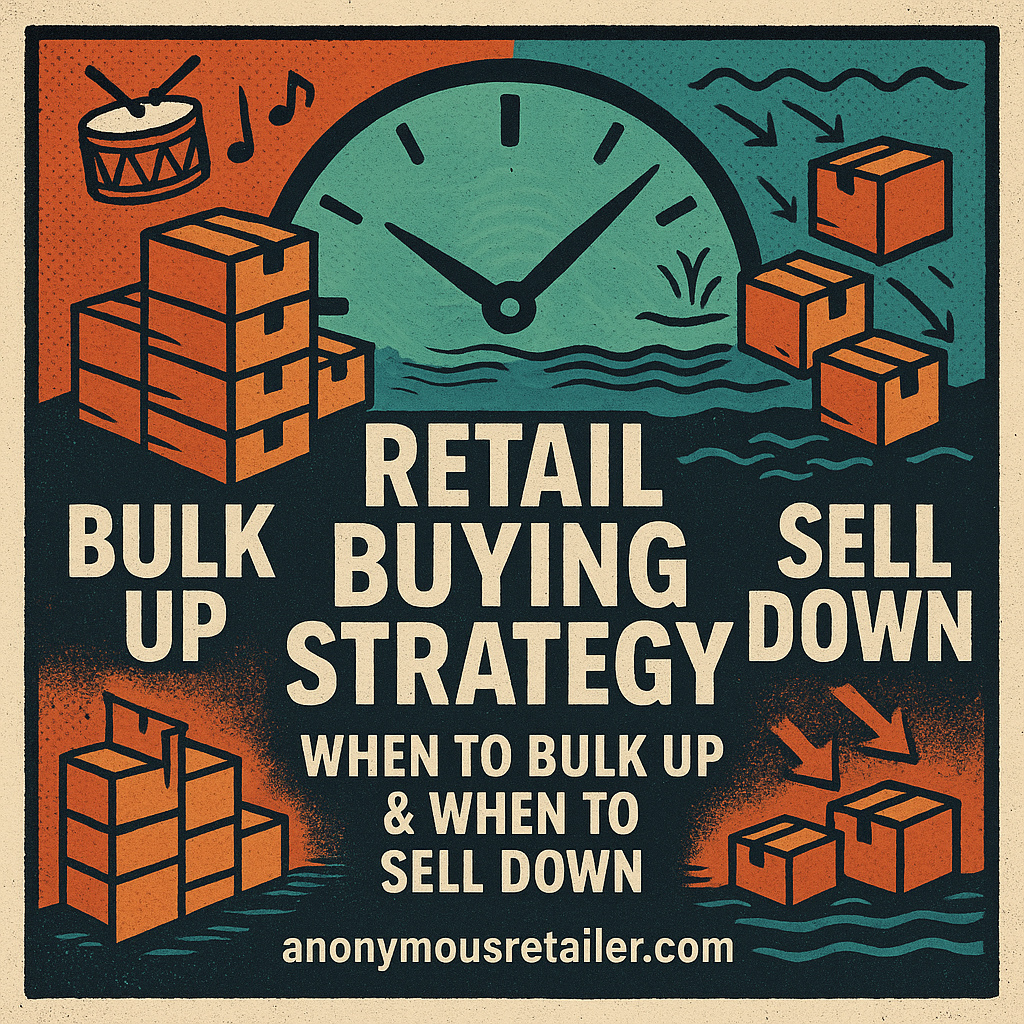
The Retail Clock Is Always Ticking
Retail buying strategy isn’t about buying the most. It’s about buying at the right time.
Too many retailers treat their backroom like a savings account — piling on inventory and hoping it matures into margin. The truth? That’s dead weight.
The best specialty retailers know when to bulk up on winners and when to sell down before the floor goes silent. Think of it like music: you bang the drums before the war, ride the rhythm in the middle, and fade out before the noise turns stale.
TL;DR
A smart retail buying strategy balances three levers — ASP as your compass, sell-through velocity as your speedometer, and timing as your clock. Bulk up before the wave of demand, hit the volume zone at full strength, then sell down as the tide recedes to protect cash and margin.
Recap the Buying Foundation
Before timing, let’s stack the first two pillars of the Retail Trifecta’s buying leg:
- Average Selling Price (ASP) as Compass
Your assortment should always point toward where customers are ready to spend. Full guide here. - Sell-Through Velocity as Speedometer
Healthy buys hit speed, not just size. See last week’s post.
Now comes timing — the retail clock that tells you when to bulk up and when to scale out.

Bulk Up: Riding the Wave of Demand
If you’re on offense, you bulk up. And you do it before the wave hits, not after.
Signs It’s Time to Bulk Up
- Proven winners: SKUs consistently hitting — and even increasing — ASP while maintaining strong sell-through targets.
- Seasonal peaks: Back-to-school, holiday, tourist season — the moments you know will bring a flood.
- Volume bands: Core sizes or hot categories where demand stacks high.
Floor Snapshots
- That stack of hoodies moving in three sizes every day? Bulk up.
- Those bikes you can’t keep assembled fast enough? Bulk up.
The Payoff
- Momentum compounds when you double down early.
- Stronger retail assortment planning around what customers already proved they’ll buy.
- A chance to grab market share before competitors realize what’s happening.
💡 Retail Gem: If it’s moving fast and lifting ASP, don’t trickle in. Load up.
Sell Down: When the Volume Fades
If bulking up is offense, selling down is defense. Both win games.
The rhythm follows last week’s volume zones:
- Bulk up before the wave — stack inventory ahead of customer demand.
- Hit the volume zone at full strength — ride it like the tide rolling in.
- Sell down as the tide recedes — exit while you still control cash.
Signs It’s Time to Sell Down in Retail
- Volume fades: Velocity stalls and you’ve passed the peak.
- Stalled momentum: The floor feels quiet around a category.
- ASP drift: Customers shift down and stop transacting at that price point.
Floor Snapshots
- That “must-have” colorway nobody’s picked up in two resets? Sell down.
- Those outerwear pieces just past the season’s peak? Sell down.
How to Sell Down Without Panic
- Scale out gracefully: Ride the wave down, don’t cling until it crashes.
- Reinvest OTB: Pull cash from fading SKUs and push it into the next rising tide.
- Bang the drums before the war: Marketing should drive the peak. Once the music fades, don’t fight it — exit clean.
💡 Retail Gem: If the tide’s rolling out, don’t stand still. Move your cash to the next wave.
The Retail Buying Cycle: Flywheel in Motion
Timing your buys isn’t a trick — it’s the system that keeps the Trifecta turning.
- Buying → Marketing: Targeted timed buys give marketing a clear story to amplify.
- Marketing → Selling: Promotions drive velocity, helping you hit sell-through goals.
- Selling → Buying: The floor talks back — and tells you where to bulk up next.
That’s the retail buying cycle: perpetual, disciplined, and cash-conscious.
💡 Retail Gem: Don’t break the loop — every decision fuels the next.
Conclusion: The Buying Leg Complete
This post closes the Buying portion of the Retail Trifecta:
- ASP is your compass.
- Sell-through is your speedometer.
- Timing is your clock.
Master these three, and your retail buying strategy stops being guesswork — it becomes a system.
Look at your floor today: Where are you bulking up? Where are you scaling out? Protect your cash, push your margin, and keep the cycle flowing.
If this breakdown sharpened your approach, don’t keep it to yourself — share it with another specialty retailer who’s still drowning in stale stock. And subscribe now, because the next Trifecta move drops soon, and you’ll want the edge before your competitors do.
Frequently Asked Questions (FAQ)
A retail buying strategy is the system you use to align what you purchase with how, when, and where your customers buy. It blends ASP targeting, sell-through velocity, and timing — so you bulk up on proven winners and sell down when volume fades.
You bulk up before the wave of demand — not after. Look for SKUs that are consistently hitting (and even raising) ASP while maintaining velocity, seasonal demand spikes like back-to-school, and categories inside strong volume bands.
You sell down when the volume fades — after the peak zone, when velocity drops or ASP drifts lower. Selling down early protects cash and allows you to reinvest in fresh assortments before products get stale.
Volume zones show where your customers are transacting most often. Bulk up heading into a zone, scale in at the peak, and sell down as the tide recedes. This keeps your inventory tuned to real demand instead of guesswork.
Buying is the first leg of the Retail Trifecta. Timed buys create stories for marketing to amplify, which in turn drives selling velocity. The selling feedback then loops back to buying — creating a flywheel where each leg sharpens the others.


