
Introduction
A strong retail sell-through strategy turns empty racks into proof that you’ve converted inventory into operating fuel. Too many retailers settle for a 50–60% sell-through and leave margin dollars trapped in slow movers. That’s inventory sitting on the shelf instead of cash working in the register.
The fix? Push for 75–85% sell-through by aligning your average selling price (ASP in retail), managing volume bands, and running a disciplined 90-day cycle. This builds off last week’s ASP post — and ties back to our earlier breakdown of the cash conversion cycle in retail. Together, these are the gears of the retail trifecta strategy: buy smart, amplify the assortment through your marketing channels, and sell through at speed to fund operations.
TL;DR
A disciplined retail sell-through strategy targets 75–85% sell-through at the right ASP, flipping inventory into cash faster, maximizing margin revenue in retail, and powering your 90-day cycle.
Connecting ASP to Sell-Through Velocity
ASP isn’t just a number in your POS — it’s the buying decision that sets the pace. Keep your assortment near the right ASP, and units move. Drift too high, and customers hesitate. Drift too low, and you leave dollars on the table.
The cost of the assortment is fixed. Markup is what’s sitting on your floor waiting to be captured. Margin is what you actually put in the till when the transaction closes.
- You might have 50% markup sitting in the assortment, but if you overbought against your retail volume bands or ignored ASP discipline, you’ll end up cutting price just to keep goods moving.
- That gap between markup and realized margin is what bleeds retailers dry.
As we laid out in Retail Inventory Margin Strategy, margin revenue in retail is the fuel that pays the bills. ASP discipline and healthy sell-through convert markup into margin — and that’s what covers rent, payroll, and future buys. Miss it, and you’ll end up working harder for less.
Coaching line: “Markup is potential. Margin is realized. ASP and sell-through are the bridge between the two.”
Begin With the End in Mind
What do you want the end of the cycle to look like?
You can line up ASP, manage sell-through with precision, and extract the margin needed to operate. Or you can ignore the signals — push ASP outside what your customer is willing to pay, overload the floor against retail volume bands, and end up hacking margin just to move bulk inventory.
One truth holds either way: time will pass, and the bills will come due. You can run smart and disciplined, or you can dig holes you’ll have to markdown your way out of.
Every retail assortment planning decision has one ultimate test: does it sell through at the pace and profitability that keeps the business healthy? Begin with that end in mind, and you’ll plan ASP with discipline, respect volume bands, and keep cash turning on a 90-day cycle.
Ignore it, and you drift off price, slow velocity, and cut margin. That doesn’t just clear inventory — it devalues your portion of the vendor–retailer partnership. The vendor’s cost is locked; it’s your markup that evaporates. Every extra day on the floor is money slipping away.
Sell-Through as Both a Planning Tool and an Analysis Tool
- Sell-Through as a Planning Tool
- Set your sell-through target up front (75–85% is the sweet spot).
- Build your open-to-buy in retail (your inventory budget) around that velocity.
- Align ASP so every unit that moves contributes margin dollars to cover operating costs.
- Sell-Through as an Analysis Tool
Inventory sell-through analysis also tells you the truth about how the last buy is performing. Spotting Winners- High sell-through at strong ASP = proven demand.
- A sharp operator will always ask: Why did this work?
- Placement on the floor?
- Marketing push?
- Seasonal timing?
- Or simply priced right?
- Knowing the “why” helps you repeat success without leaving money behind.
- Winners are the SKUs to reorder, feature in marketing, or lean into next cycle.
- They don’t just deliver margin — they train customers to come back early before stock runs out.
- Example: if an assortment enters at a 50% initial markup (IMU) but half sells at 50% off:
- You only covered the cost of goods.
- You generated $0 in margin revenue to fund operations.
- Your portion of the vendor partnership is devaluing daily.
- That’s why markdown strategy in retail is just recovery — not growth.
“Sell-through doesn’t lie. It shows you what’s fueling your business and what’s draining it.”

Why 75–85% Sell-Through is the Sweet Spot
Below 60% sell-through, too much cash is locked in racks. At 75–85%, you’ve struck balance: fast enough turns to keep cash flowing, while still banking strong margin at full price. Go over 90%, and you risk underbuying — leaving dollars on the table because you ran dry too early.
Cash Conversion Cycle Callout
The cash conversion cycle (CCC) measures how long it takes to turn inventory back into usable cash.
- For most specialty retailers, with customers paying at the counter and vendors on 30-day terms, the cycle runs about 60 days.
- For B2B businesses working on net-30 invoicing, the cycle stretches closer to 90 days.
The lever that shortens CCC is velocity: the faster you sell through, the sooner your dollars are free to reinvest.
“Think of CCC as your cash clock — sell-through speed is what keeps it ticking.”
The Story of a Markdown
Markdowns look like they’re helping — racks are clearing, units are moving — but in reality, they’re just patching a mistake made earlier in the cycle. When ASP isn’t respected or the buy is too heavy against the volume, you end up cutting price just to keep velocity alive.
The problem? Every markdown trims away the very dollars you need to operate. What started as potential profit turns into margin leakage — money that should have been fueling rent, payroll, and future buys is gone.
Markdowns don’t create strength, they just expose the weakness of inaccurate buying.
“Markdowns aren’t a strategy — they’re the tax you pay for buying mistakes. Nail ASP and volume on the front end, and you won’t be discounting your way out of holes later.”
Identifying Winners with Analytics
You don’t get to 75–85% sell-through by guessing. Use analytics to rank SKUs by:
- Sell-through % (velocity)
- Margin dollars (impact)
- ASP alignment (profitability)
Action Plan:
- Protect winners — reorder, feature, market them.
- Clear laggards — reposition, bundle, markdown if you must.
“Protect the cows that moo, clear the ones that don’t.”
Managing Volume Bands, Tides & Timing
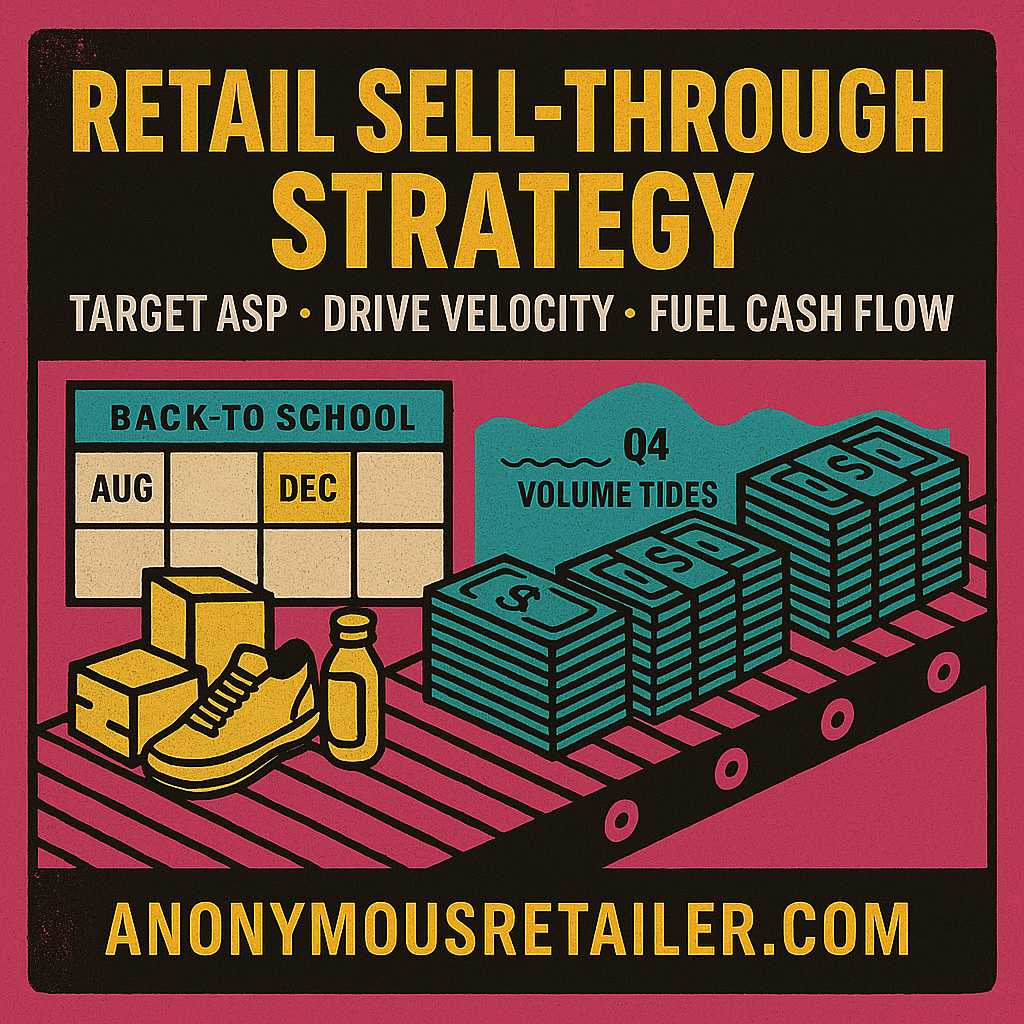
Every month has a high-volume zone — some far bigger than others. These zones, and the tides that build into and out of them, are where margin is either captured or lost.
Example:
- In Q4, December is the dominant volume band. Tides build in from Black Friday, crest in December, and taper into January.
- In July, fireworks may only move for a two-week band, but the same principle applies — velocity in the band is everything.
- Back-to-school, spring break, summer travel — each month has its own high-volume band with tides rising and falling around it.
To target effective sell-through:
- Identify the high-volume zones in each month.
- Manage ASP and inventory so you’re positioned to sell through quickly inside those bands.
- Extract margin aggressively while the tide is in — don’t be left heavy when it rolls out.
Even the strongest assortment will stall if customers don’t know about it. Marketing puts wind behind sell-through velocity — awareness is what keeps the tide flowing at full strength.
“Every month gives you a chance to extract margin in its volume band. Some bands are small, some massive — but if you miss them, you’re leaving cash on the table.”
Building a 90-Day Plan
Retail runs on rhythm. Treat each retail 90-day cycle as a scoreboard:
- Day 30: Early reads — spot traction.
- Day 60: Confirm winners, double down, start clearing laggards.
- Day 90: Exit underperformers, free cash, reorder winners.
Each cycle is the retail trifecta strategy in motion: buy smart, amplify the assortment, sell through at speed.
Success story: Retailers who stay disciplined here often find cash gaps shrinking. Once you run surplus cycles — paying bills early, reinvesting in winners, skipping the panic markdowns — you don’t go back.
Coaching line: “Your 90-day plan decides whether cash is flowing or stuck.”
Conclusion
Hitting 75–85% sell-through at the right ASP is the most reliable way to generate margin revenue, shorten your cash cycle, and keep operations funded. Sell-through is both a planning tool and an analysis tool — it sets your aim and tells the truth about how your buys performed.
This is the essence of a disciplined retail sell-through strategy: buying the right ASP, amplifying the assortment through your marketing channels, and selling it through at speed to keep dollars in motion. Do this, and your inventory isn’t just product — it’s cash at work.
And for the Wu-Tang fans reading this: cash rules everything around you (and me). That’s the whole point — targeting OTB dollars with analytics and velocity to build strong, reliable cash flow. We’re in the retail business, not the recoup business. Start at the beginning: target strong margin streams by first identifying where the customer wants to transact through ASP, then build compelling assortments around those price bands — gradually pushing ASP higher. Hit sell-through targets that don’t blow out your OTB dollars, and you’ll keep cash flowing and assortments fresh. See you next week with another update!
If this hit home, share it with your network and subscribe now so you don’t miss next week’s post: When to Bulk Up & When to Sell Down — how to time buys with customer demand, leverage selling cycles, and avoid over-inventory.
For the sell-through formula itself, including how to handle reorders, see our Essential Retail Math Terminology guide.
FAQ
A retail sell-through strategy is the process of planning, buying, and selling with the goal of achieving a high percentage of product sell-through — ideally 75–85% — at the right average selling price (ASP). The strategy ensures inventory turns into margin revenue and cash flow instead of sitting on the floor.
At 75–85%, inventory moves fast enough to keep cash flowing while still capturing maximum margin at full price. Below 60% leaves too much capital tied up in slow movers. Over 90% often means you under-bought, leaving sales and margin on the table.
Average selling price (ASP) sets how much margin each unit contributes when it sells. If ASP drifts too high, velocity slows. If it’s too low, you leave operating dollars on the table. Aligning ASP with customer demand ensures products move at speed while generating the margin revenue needed to cover rent, payroll, and future buys.
Every month has a high-volume zone — like December in Q4 or back-to-school in August. These are volume bands. The demand that builds into and out of those zones are the volume tides. Identifying both allows retailers to position inventory, manage ASP, and extract maximum margin during the peak demand window.
High sell-through shortens the cash conversion cycle — the time it takes to turn inventory back into usable cash. Faster turns mean dollars are freed sooner to cover expenses, reinvest in winners, and avoid relying on credit or reserves.


