
Introduction
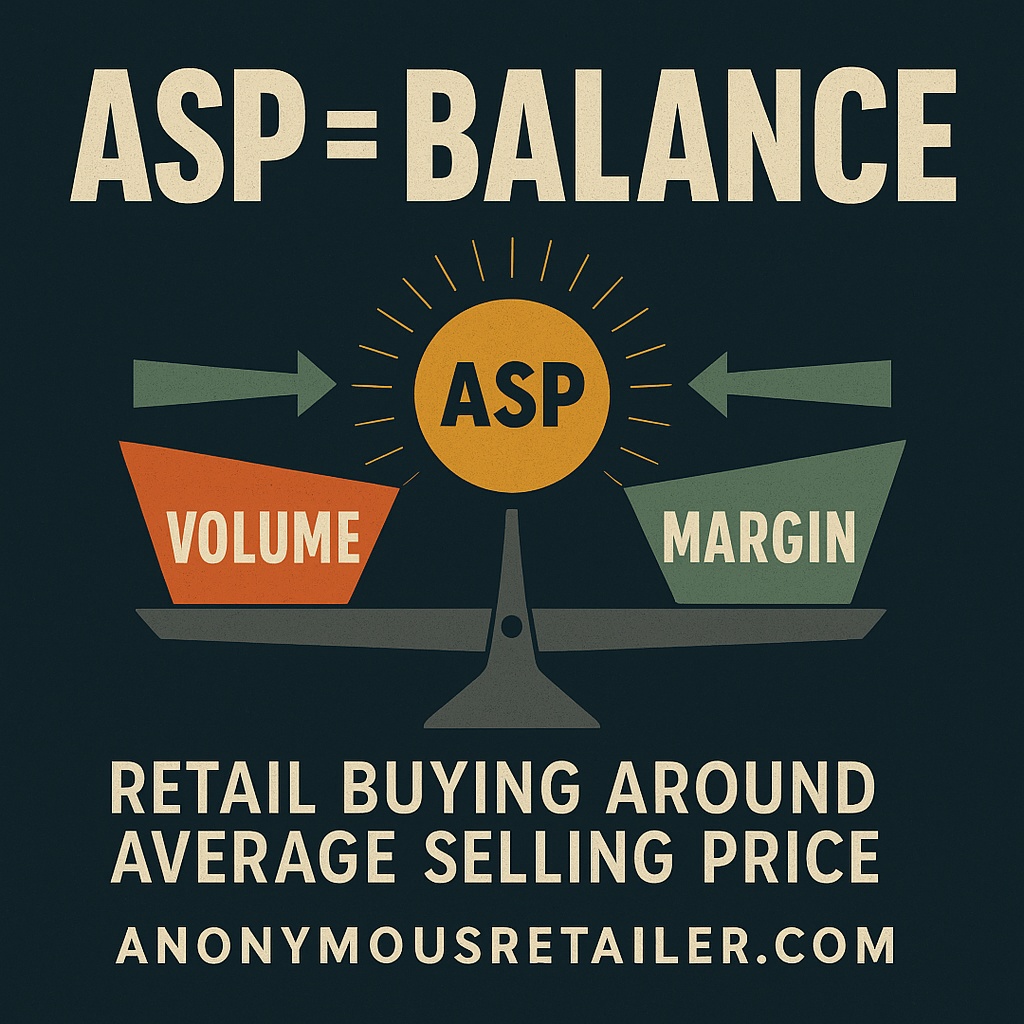
Retail buying around average selling price is the reality check every retailer needs. You might love a $200 jacket, but if your customer lives at $120, ASP is telling you the truth. It’s the balancing point between volume and margin extraction—your compass for building assortments that support cash flow instead of draining it.
In this post, we’ll cover how to calculate ASP, why it’s the clearest signal of customer confidence, what causes it to rise or slide, and how Buying, Marketing, and Selling each keep it in balance as part of the Retail Trifecta.
TL;DR
Retail buying around average selling price is the balancing point between volume and margin extraction—and the entry point into the Retail Trifecta. ASP tells you where your customer wants to buy, Marketing sustains it, and Selling expands it. Ignore it, and you’re not buying—you’re gambling.
Why Retail Buying Around Average Selling Price Matters
Every retailer has that moment—they fall in love with a line of $200 jackets while their customer happily lives at $120. ASP is the reality check.
In the Retail Trifecta framework (Buying → Marketing → Selling), ASP is where it all starts. Customers show you their comfort zone, and your job is to build assortments that protect and expand margin extraction around that zone.
When assortments drift:
- Too far above ASP: Units stall until you cut prices back into ASP territory, gutting margin.
- Too far below ASP: You generate volume, but the dollars extracted aren’t enough to support operations.
ASP keeps Buying grounded in customer truth. Bias is noise; ASP is signal.
If you don’t measure and respect ASP, you’re not buying—you’re gambling.
How to Calculate ASP in Retail
The formula is simple, but the discipline is rare: ASP = Total Net Sales Dollars ÷ Total Units Sold
Example: $120,000 ÷ 1,000 units = $120 ASP.
This is the foundation of retail buying around average selling price. Run the calculation every 30–90 days by category. If you’re not pulling ASP consistently, you’re not buying with clarity—you’re guessing.

ASP as the Balancing Point Between Volume & Margin Extraction
ASP is the fulcrum on the Retail Trifecta seesaw:
- At ASP: Buying, Marketing, and Selling all reinforce each other—margin capture and unit velocity align.
- Above ASP: Inventory slows, Marketing has to rely on discounts, and Selling is forced to justify pricing the customer doesn’t believe in.
- Below ASP: Units move, but Selling is stuck in transactional mode and Marketing is left telling a “cheap” story. Margin extraction thins out.
Retail assortment balance comes from keeping Buying centered at ASP, while Marketing and Selling keep it supported.
What Moves ASP Up or Down
ASP Expanding Upward (the Goal)
- Buying discipline: Balanced good-better-best ladders, with “better” as the anchor.
- Marketing storytelling: Campaigns highlight value, justify step-ups, and build brand trust.
- Selling execution: Active selling expands baskets and steps customers into higher-value products.
Effect: Higher margin extraction per unit while sustaining velocity—this is the Trifecta working in sync.
ASP Sliding Downward (the Risk)
- Buying mistakes: Overweighting entry-level products dilutes balance.
- Marketing misfires: Heavy promotions or price-led messaging pull ASP down.
- Selling gaps: Passive selling leaves step-ups untapped.
- Customer headwinds: Economic or competitive pressure lowers the spend ceiling.
Effect: Units rise but dollars shrink, forcing larger assortments and tying up OTB.
Think you can outsmart ASP with promotions? The markdown report will prove otherwise. And if you think you can make it up in volume, your P&L will disagree too. Your monthly margin needs don’t bend just because you sold more units—they’re fixed. If ASP slides down, you’ll burn more inventory, work harder, and still come up short of the dollars required to cover expenses.
What Your Customer Is Really Telling You Through ASP
ASP isn’t just math—it’s a live conversation with your customer.
- Stable or growing ASP: Buying is disciplined, Marketing is building value, Selling is expanding sales. You’re in sync.
- Declining ASP: The customer is signaling the Trifecta is broken. Either assortments are off, Marketing is leaning too hard on promos, or Selling has gone passive.
ASP is the customer’s vote of confidence in your strategy. Respect it, and the loop holds. Ignore it, and the cycle collapses.
ASP in the Retail Trifecta Flow
ASP is not a silo—it’s the hand-off that keeps the Retail Trifecta perpetual.
- Buying: Start with ASP clusters. This is where customers want to buy and where you must plan OTB.
- Marketing: Amplify ASP value in campaigns. Done right, you reinforce confidence and sustain ASP growth. Done wrong, you dilute it with discounts.
- Selling: Active selling expands ASP upward, while passive selling allows it to slide down. Step-ups, attachments, and confidence at the register expand margin dollars.
- Loop: Selling results reset ASP, feeding directly into the next Buying cycle.
This perpetual flow is what makes the Retail Trifecta powerful. ASP is the lever that keeps it balanced.
Call-Outs: This Week’s ASP Action Plan
- This week, pull your last 90 days of sales by category.
- Rank items by margin dollars extracted, not just units.
- Identify your ASP “comfort zone” cluster.
- Audit your OTB—are you aligned with ASP, or drifting above or below?
- Track ASP trendlines: stable, expanding, or sliding?
- Reweight 10% of your next OTB into ASP-centered products and measure the margin lift in 30 days.
Conclusion
Retail buying around average selling price is more than a math formula—it’s the launchpad for the entire Retail Trifecta. Get it right, and Buying, Marketing, and Selling all work in sync to expand ASP and extract margin effectively. Get it wrong, and you either bleed margin through markdowns or chase hollow volume that never covers expenses.
Respect ASP, or risk gambling with your margin.
ASP is the clearest signal of where your customer wants to do business with you. Build assortments that support and expand ASP, and you’ll keep the Retail Trifecta in perpetual motion.
Next week, we’ll layer in sell-through—because ASP shows you where to buy, but sell-through shows you how fast margin is being captured.
👉 If this breakdown helped sharpen your strategy, share it with another retailer who needs it and subscribe to AnonymousRetailer.com so you don’t miss the next part of the Trifecta series.
Frequently Asked Questions (FAQ)
Retail buying around average selling price means planning assortments based on the actual price customers are willing to pay. It ensures you align inventory with demand, protect margin extraction, and avoid overstocking products that require markdowns.
The formula is simple:
ASP = Total Net Sales Dollars ÷ Total Units Sold
This calculation shows the average price customers paid per unit and should be tracked every 30–90 days by category.
ASP is the balancing point between volume and margin. Buying above ASP often leads to markdowns and lost margin, while buying below ASP increases unit velocity but dilutes margin dollars. Staying near ASP keeps assortments balanced and cash flow protected.
ASP expands upward when marketing builds value, selling teams actively step customers up, and assortments are laddered effectively. ASP slides down when assortments drift into low-end product, promotions dominate the story, or selling execution is passive.
ASP is the entry point into the Retail Trifecta. Buying decisions should anchor around ASP, Marketing should reinforce its value, and Selling should expand it through active engagement. Selling results reset ASP, which then informs the next Buying cycle.


