
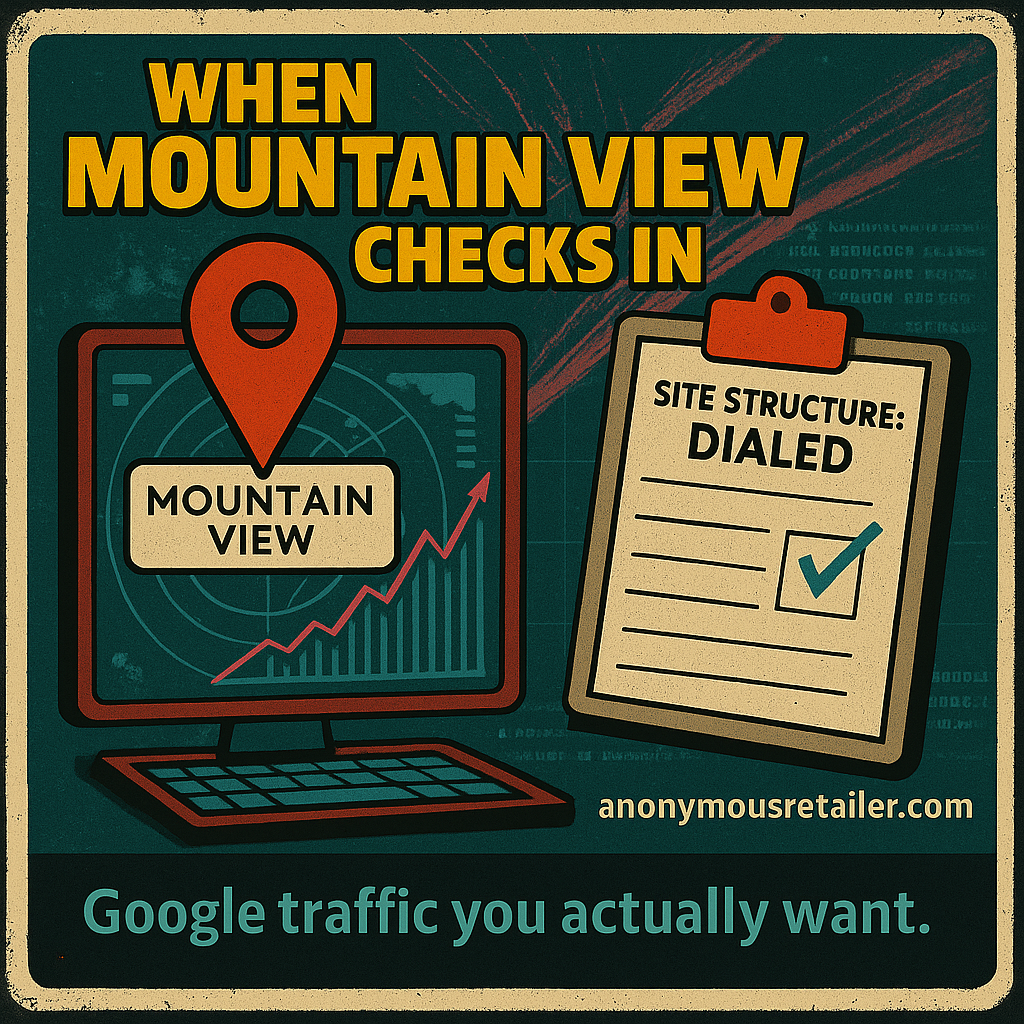
Every time I see Mountain View website traffic in my analytics, I take notice—because when Google checks in, something bigger may be brewing. For specialty retailers and digital marketers alike, this quiet signal from the heart of Silicon Valley might mean your content is getting more than just indexed. It might be getting evaluated.
This post breaks down what it means when Mountain View shows up, why it’s a good sign, and how to keep earning those visits.
📦 TL;DR
Mountain View website traffic often originates from Google’s headquarters. It can signal indexing, human evaluation, or LLM testing of your content. If you see it regularly, it may be a sign your site is growing in authority and relevance. Keep publishing, stay structured, and track how those visits correlate with visibility in Search Console.
I. Why Mountain View Traffic Gets Attention
A. The Google Connection
Mountain View, California, isn’t just any dot on the map—it’s the home of Google HQ. When you see traffic from this city in your analytics, it’s not unreasonable to wonder if your content is being seen by:
- Googlebot crawlers
- Google Search Quality Raters
- Engineers working on Search, Gemini, or SGE
- LLM training pipelines evaluating content
- Product teams running internal tests
In short: this isn’t passive traffic—it’s often exploratory, evaluative, or structural.
B. Personal Insight: Why I Track It
As much as this blog is a place to air out my specialty retail thoughts, it also doubles as a proving ground to keep my skills in web marketing, SEO, and site architecture razor sharp. One of the key signals I track is how often Mountain View checks in. Every visit from Google’s backyard doesn’t just feel validating—it strengthens my site’s organic roots. It’s a subtle but powerful indicator that the content is relevant, the authority is building, and the algorithm is paying attention.
II. What a Visit from Mountain View Might Mean
A. Crawling & Indexing Activity
- A fresh or updated page might be getting revisited
- It could signal Google is testing how to classify or display your content
- Watch for crawl spikes and new snippets appearing
B. Quality Rater Evaluation
Google employs human raters to evaluate site content against E-E-A-T guidelines (Experience, Expertise, Authoritativeness, Trust). Traffic from Mountain View may reflect this kind of review—especially after significant updates.
C. Inclusion in LLM Pipelines
As Google evolves Search into a generative engine, it’s crawling high-quality sites to feed AI systems. Mountain View website traffic might correlate with content being pulled into SGE results, Gemini summaries, or AI training datasets.
III. Why It’s a Positive Signal
If you’re seeing consistent or recurring visits from Mountain View:
- You’re on the radar for algorithmic review or testing
- Your pages are being viewed as potentially valuable reference content
- You might soon see increased Search Console impressions, crawl frequency, or ranking movement
This isn’t just theory—here’s what happened in my case:
About this time last year, I noticed a concentrated burst of Mountain View website traffic over a two-week period. Roughly two weeks later, my content started showing up in Google with rich search results—enhanced snippets, FAQ blocks, and schema-driven features.
I’m not running ads. I’m not paying to promote my content. I’m building slow, steady, and structured. That moment was the holy grail of organic acknowledgment.
Since then, my traffic has grown, and those Mountain View visits have become a near-weekly occurrence. That was the confirmation I needed: my site was structurally dialed, and Google was signaling relevance in my space.
Whether it’s cause or correlation, it was clear that something had shifted.
IV. How to Encourage More Check-Ins
✅ 1. Publish Thoughtful, Structured Content
Google thrives on clarity. Use:
- Clear H2/H3 formatting
- AI-readable summaries
- Schema markup (especially Article and FAQPage)
✅ 2. Maintain Technical SEO Health
Keep the house in order:
- Fast page loads
- Zero crawl errors
- Mobile-friendly layouts
- Updated sitemaps and robots.txt
✅ 3. Focus on Authority Signals
Attract links, mentions, and shares from reputable sites in your niche. Publish unique takes and frameworks. Google’s models crave freshness and originality.
✅ 4. Optimize for Humans and Machines
Include natural language summaries, bullet points, and explanations that work for both readers and LLMs. Think: “If Gemini or SGE had to explain this page, could it?”

V. How to Track Mountain View Website Traffic in Analytics
You can spot these visits using:
- Google Analytics Location > City > Mountain View
- Log files or server data (for IP detail or bot signatures)
- Google Search Console Watch for crawl activity, sitemap hits, or URL inspection spikes
Use UTM parameters to track campaigns. Monitor if Mountain View visits correlate with:
- Impressions increasing
- New keywords ranking
- Snippet appearance or AI summary inclusion
VI. Final Takeaway: You Can’t Game Google—But You Can Attract It
🟨 “You can’t game Google—but when Mountain View checks in, your structure is working.”
The goal isn’t to chase Mountain View—it’s to build content that deserves to be seen from Mountain View. If they’re checking in, you’re doing something right.
Keep creating. Keep refining. Keep showing up with content that earns trust—both from humans and the algorithm.
📣 If This Hit Home…
🧭 Share it with someone tracking their SEO the hard way.
📬 Subscribe to get weekly frameworks, reflections, and strategies for building organic visibility that lasts.
🧠 Because in a world of AI summaries and search shifts, structure still wins.
❓ FAQ Section
It refers to visits from Mountain View, CA—home to Google’s headquarters. These can be from bots, employees, or raters interacting with your site.
Not directly—but it’s often correlated with increased visibility, crawl activity, or inclusion in new search experiences.
You can’t force it, but publishing high-quality, well-structured content and optimizing for AI readability makes your site more attractive for Google’s systems.
Use server logs, Cloudflare analytics, or filters in GA4 to see user-agent strings and session behavior. Short sessions with minimal interaction usually indicate bots.
🧠 Challenge for the Reader
“If Mountain View shows up tomorrow—what’s the one page you hope they’re looking at?”
Make that your most valuable, structured, and engaging page on your site.


